Paper on the influence of measurement frequency on energy readings with Intel RAPL and NVIDIA NVML published at HotCarbon 2026
The paper „Evaluating the Influence of Measurement Frequency on Energy Readings Using Intel RAPL and NVIDIA NVML“ has been accepted for publication at the HotCarbon Workshop on Sustainable Computer Systems 2026.
It was written by Maximilian Dauner, Manuel Steinberg, Prof. Dr. Andreas Brunnert, Benedikt Schicker and Benedikt Zönnchen – a collaboration between MUC.DAI and the Department of Computer Science and Mathematics at Munich University of Applied Sciences HM.
What it is about
Anyone measuring the energy consumption of software usually relies on hardware counters: Intel RAPL for processors, NVIDIA NVML for graphics cards. How often those counters are read is typically treated as a detail. The study shows that this is a mistake – and that the two interfaces behave in fundamentally different ways.
- NVML: The cumulative energy counters frequently return stale reads at intervals below 100 ms and show strongly platform-dependent behaviour.
- RAPL: Readings remain stable at sampling intervals of 10 ms or coarser. Sub-millisecond sampling, by contrast, only increases overhead without improving accuracy.
For energy attribution tools this means: avoid unvalidated cumulative NVML energy counters on NVIDIA GPUs and integrate over power instead, and sample RAPL at moderate rather than sub-millisecond intervals.
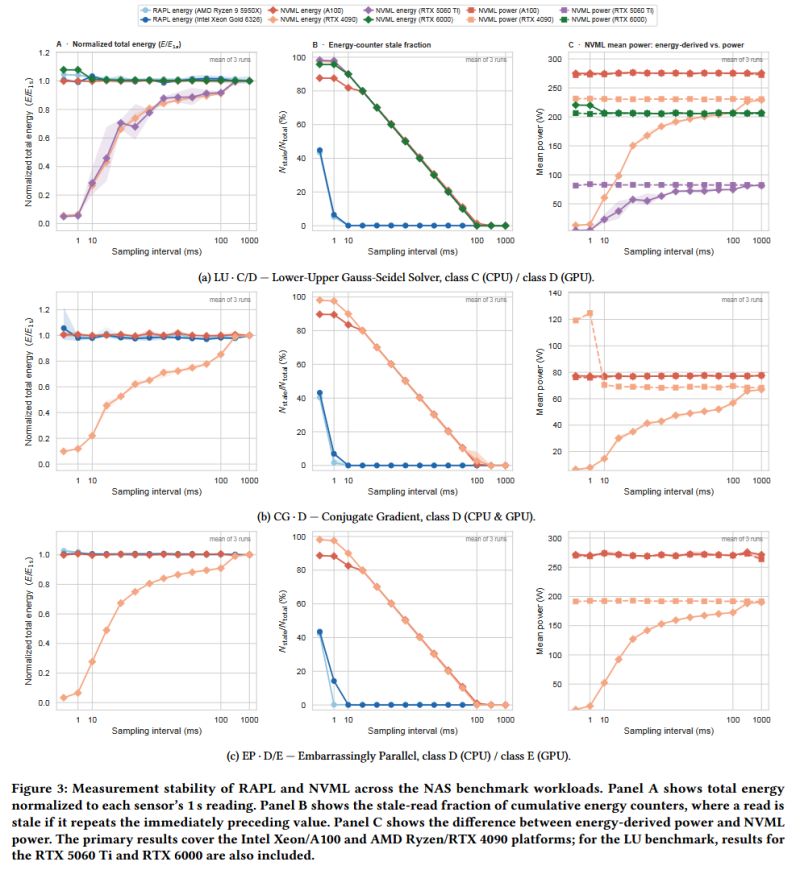
Figure 3 from the paper: measurement stability of RAPL and NVML across the NAS benchmark workloads. Panel B shows the stale-read fraction of the cumulative energy counters – a read counts as stale if it repeats the immediately preceding value.
The HotCarbon Workshop on Sustainable Computer Systems 2026 took place from July 16th to 17th, 2026 at the University of Washington in Seattle. The paper was presented on July 17th in the „Hardware“ session.
The full paper is available here: https://hotcarbon.org/assets/2026/paper-46.pdf